Why dehumidify in a dry climate?
We can answer that briefly and concisely: "This offers various financial advantages depending on the situation."
We've listed them for you.
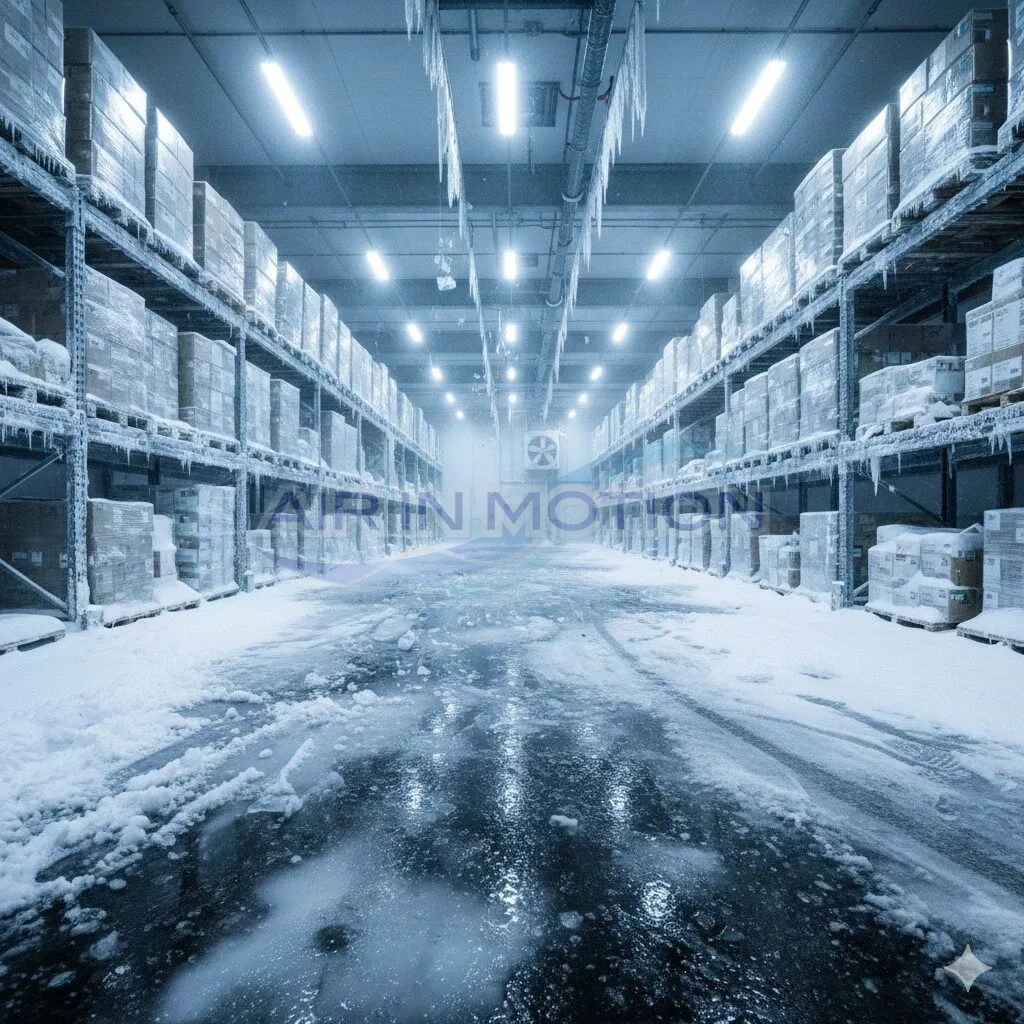
The financial advantages of a desiccant dehumidifier in a -20°C freezer area almost always lie in the costs you avoid:
- Ice/frost
- Breakages
- Downtime
- Energy spikes due to defrosting
When is it financially interesting?
We recommend investing in an adsorption dryer for cold storage/freezer/deep freezer if one or more of the following applies:
- Many doorways or large door sizes (high moisture ingress)
- No (adequate) airlock/antechamber
- Demonstrably high defrost hours
- Ice problems on floors/doors
- High downtime costs/safety incidents
For more information, see our AFIM Dry Freeze webpage.
The main cost items:
1. Less ice and frost buildup → lower cleaning and labor costs
- Less manual scraping/chipping, less use of scrubbers, less salt/chemicals.
- Less time lost at docks, doors, walkways, and racks.
Financial impact:
- Structural savings on man-hours
- Less operational disruption
2. Reduced slip/collision damage and liability risk
- Less ice on floors and at doors reduces the risk of incidents involving employees and internal transport.
Financial impact:
- Reduced damage
- Reduced absenteeism costs
- Lower deductibles/claims (more difficult to quantify, but often substantial).
3. Less frequent and shorter defrosting of evaporators
Incoming moisture settles on the evaporators as frost → poorer heat transfer → more frequent/longer defrosting. With drier air, the evaporator stays "clean" longer.
Financial impact:
- Less energy required for defrost (electric/gas/hot gas),
- Fewer product temperature fluctuations,
- Fewer hours with lower cooling capacity.
4. Lower cooling load due to improved cooling efficiency (COP/efficiency).
If evaporators freeze up less:
- Fans run more efficiently (less pressure loss),
- Lower evaporation temperature corrections are required,
- Compressors don't have to work as hard.
Financial impact:
- Savings on kWh from cooling (can be substantial, but depend heavily on the current frost buildup on the evaporators).
5. Reduced maintenance and malfunctions of doors, dock shelters, and equipment.
Frost/ice causes:
- Doors freeze shut,
- Damaged seals, heaters that run continuously,
- Increased wear and tear on forklift wheels and bearings (due to ice/uneven floors).
Financial impact:
- Fewer repairs,
- Fewer parts,
- Fewer service visits.
6. Reduced product loss / quality loss
With frequent defrosting and moisture problems:
- More temperature peaks,
- More condensation when moving pallets,
- Packaging damage (cardboard, labels).
Financial impact:
- Fewer rejections and claims.
7. Increased uptime / higher throughput
In logistics freezers, downtime is often the largest cost item:
- Fewer blockages due to ice,
- Fewer emergency stops for defrosting or making things safe.
Financial impact:
- Higher availability and fewer missed orders/overtime.